ATC GOALS AND STRUCTURE
ATC partners serve all cities and unincorporated areas of Fort Bend County. Membership is available for representatives from regulatory agencies, social service agencies, law enforcement agencies, victim service providers, community-based organizations, faith-based organizations, and criminal justice system-based victim assistance components.
ATC Goals
Partner agencies within the ATC are committed to collaborate in the fight against human trafficking by:
- Increasing community awareness for the prevention and identification of human trafficking victims,
- Increasing investigation and prosecution of human trafficking cases at the local, state, and federal levels, and
- Providing coordinated, comprehensive, trauma-informed services to meet the individualized needs of human trafficking victims.
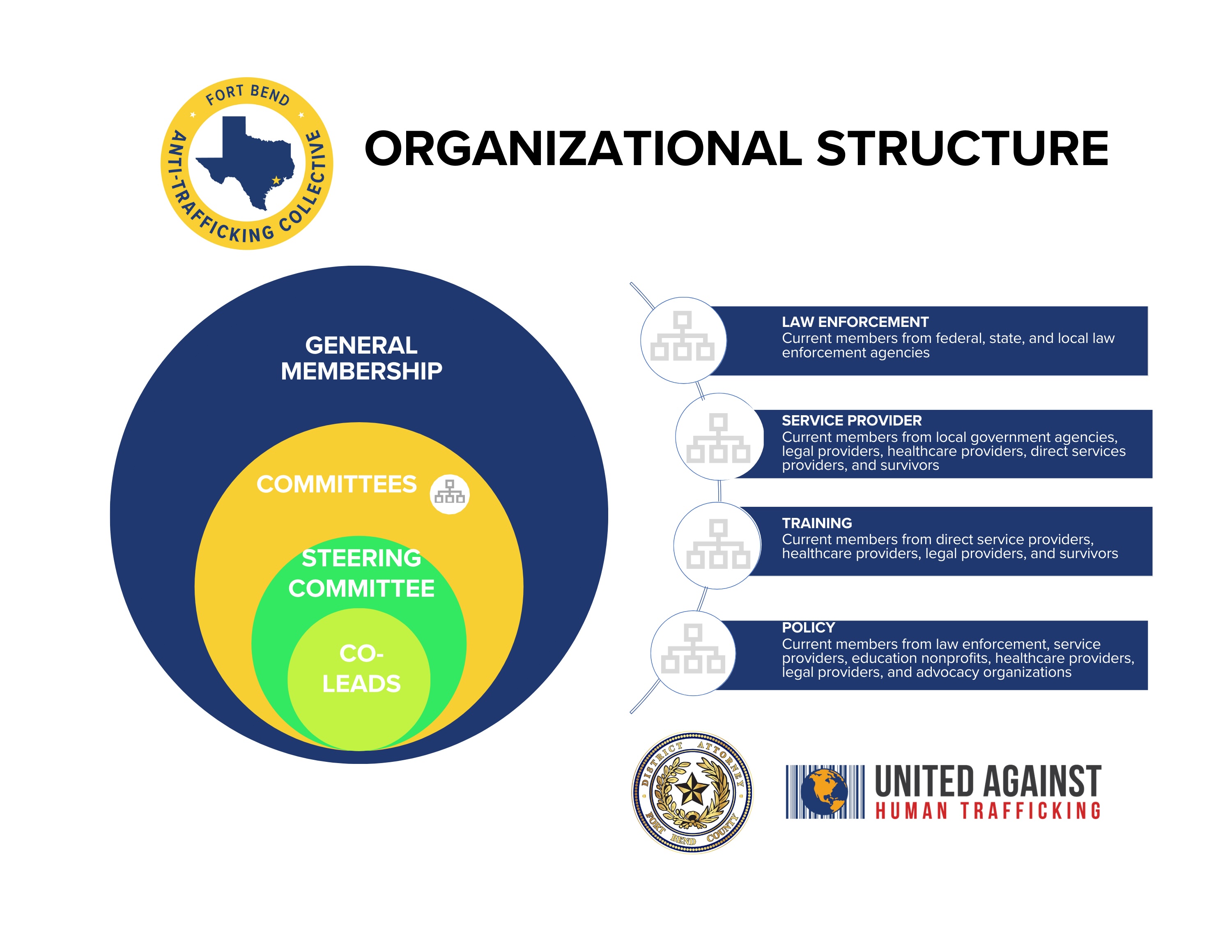
The ATC’s Co-leads are comprised of staff members from both the Fort Bend County District Attorney’s Office (FBCDAO) and United Against Human Trafficking (UAHT). Together, they are responsible for ensuring the task force’s strategic plan is completed in alignment with the Office for Victims of Crime (OVC) timeline, managing all data collection and federal reporting requirements, and serving as the final authority in resolving conflicts among task force members. Their shared leadership reflects a strong commitment to collaboration, accountability, and survivor-centered coordination.
The ATC is guided by the Steering Committee, which includes Committee chairs and key leaders from partner agencies, with equal representation from law enforcement and service providers. Members represent local law enforcement, education, victim services, and other community leaders. The Steering Committee will meet quarterly, before the combined quarterly Law Enforcement and VSP Committee meeting. During these meetings, each agency will have one vote. The Task Force Director presides over Steering Committee meetings and steers the ATC’s objectives.
The core agencies making up the steering committee of the ATC are:
Law Enforcement: Fort Bend County District Attorney’s Office, Federal Bureau of Investigations, Fort Bend County Attorney's Office, Fort Bend County CORE Court, Fort Bend County Juvenile Probation, Fort Bend County Sheriff's Office, Homeland Security Investigations, Missouri City Police Department, Texas Department of Public Safety and the United States Attorney’s Office.
Service Providers: United Against Human Trafficking, BCFS Common Thread, Catholic Charities, Child Advocates of Fort Bend, Fort Bend County Behavioral Health Services, Fort Bend County District Attorney’s Victim Services, Fort Bend Women’s Center, Hope Fort Bend Clubhouse, The Landing, Lone Star Legal Aid, Street Grace, Texas Forensic Nurse Examiners, Unbound Now Houston, U.S. Attorney’s Office Victim Services, and YMCA International.
There are four committees detailed below:
- Law Enforcement Committee - Law enforcement’s role in the ATC is to conduct criminal investigations into allegations of Human Trafficking to determine if a crime has occurred. The law enforcement partners provide a coordinated team response, with members bringing a diversity of knowledge, backgrounds, and training to the investigations. The common mission identifies a collective effort to protect the victims of human trafficking. LE meetings will be held monthly. These meetings are convened monthly and are restricted to law enforcement personnel except for the Task Force Director. Others attend by invitation only. During these meetings, local and federal law enforcement share intelligence and coordinate the investigation and prosecution of trafficking cases in the Fort Bend County regional area. The LE Enforcement Committee Chair leads LE meetings.
- Victim Service Providers Committee - The role of the VSP is to nurture and grow a network of vetted agencies, individuals, or organizations providing direct or indirect services to victims of all forms of human trafficking in the Fort Bend County area. There are two sub-groups: Child, which will be overseen by the Fort Bend Care Coordination Team, and Adult, which United Against Human Trafficking will oversee.
- Training Committee - The role of the Training Committee is to enhance the knowledge base of both internal ATC members and external community members and businesses in Fort Bend County. The Training Committee will develop a Coordinated Community Response (CCR) that identifies training needs, updates and/or develops curricula, and organizes training and outreach events for law enforcement, service providers, and the broader community. The Committee meets monthly to fulfill these responsibilities and is also tasked with collecting and analyzing data to report to the task force at quarterly meetings.
- Policy Committee – Policy is the foundation of any effective anti-trafficking strategy. Convictions, prosecutions, and service provision are only as strong as the statutes and policies that authorize and guide them. Without clear, survivor-centered laws and agency-level protocols, systems risk falling short in identifying victims, holding offenders accountable, and ensuring access to trauma-informed care. The Policy Committee of the ATC will be tasked with developing a strategic legislative agenda to advance these goals. This includes proposing and supporting state-level reforms and aligning with key federal legislation that strengthens protections for victims, expands prosecutorial tools, and ensures coordinated, sustainable responses to both labor and sex trafficking.